Tra festa, silenzio e profezia: quattro esercizi di cultura nel tempo della crisi
22 Febbraio 2026
La beffa del Tempo. Barnes vs Proust
22 Febbraio 2026Beginnings in Fragile Times: Literature, Architecture and Art Between Memory and Survival
Three recent cultural stories — spanning literature, architecture and contemporary art — trace a subtle but powerful line: creation does not disappear in moments of tension or crisis. It changes form. It becomes more conscious of its own beginnings.
In El principio del mundo (The Beginning of the World), published by Penguin Libros, Jeremías Gamboa returns to the intimate territory of formation. The novel is less about a grand origin and more about the quiet, complicated birth of a self. Gamboa explores what it means to grow up intellectually and socially in a context shaped by class divisions and unspoken hierarchies. The “beginning” is not mythic; it is awkward, strategic, emotional. It is a young man learning how to inhabit spaces that were not designed for him.
The narrative voice moves between reflection and subtle irony. Memory is not presented as a clean archive but as a fragmented terrain where ambition, shame and aspiration overlap. The smile that surfaces in the critical reading of the novel becomes a metaphor — the polished expression required to navigate elite cultural environments. Literature, in this sense, is both refuge and arena. Gamboa’s prose is restrained and lucid, resisting melodrama while revealing how deeply personal growth is entangled with structural realities. The story of one writer becomes, quietly, a portrait of a broader Latin American condition: mobility as both possibility and tension.
From the interior formation of a writer we shift to the exterior shaping of cities. The late French architect Renée Gailhoustet offers a different kind of beginning — one built in concrete, terraces and gardens.
Renée Gailhoustet reimagined postwar housing in places such as Ivry-sur-Seine as layered, inhabitable landscapes. Often described as “eco-brutalist,” her work complicates the stereotype of Brutalism as rigid and oppressive. Her buildings step outward and upward, multiplying terraces, inserting gardens into dense urban fabric, allowing vegetation to climb concrete. Long before sustainability became a planning mantra, she envisioned social housing as porous and green.
Her architecture can look almost post-apocalyptic in its sculptural intensity, yet it is profoundly social in intention. Density does not exclude generosity. Private apartments open onto semi-public terraces; the rooftop becomes a shared garden rather than a technical afterthought. In a century defined by climate anxiety and urban alienation, her projects feel less like relics and more like proposals. They suggest that the future city might not be sleek and transparent, but layered, textured, vegetal — a hybrid between infrastructure and ecosystem.
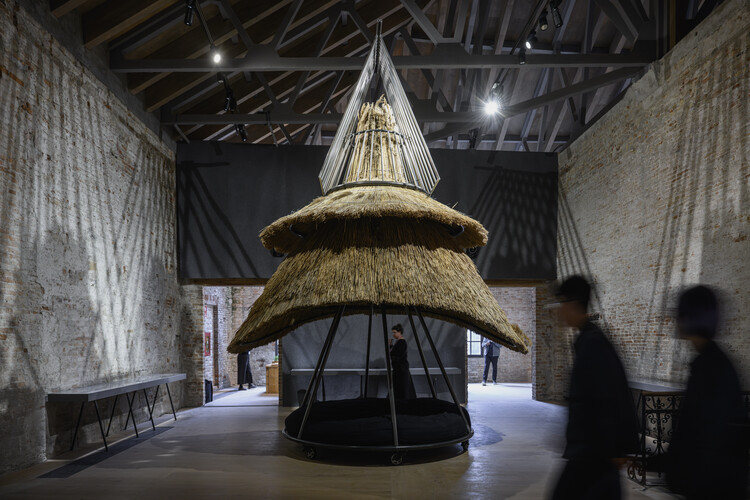
Finally, from novels and housing blocks we arrive at an artwork that has literally crossed a battlefield. A sculpture evacuated from the Russian front will stand at the center of the Ukrainian Pavilion at the Venice Biennale.
Removed from an active war zone, the piece carries not only aesthetic ambition but the fact of survival. Its evacuation is part of its meaning. Once threatened by destruction, it now occupies one of the art world’s most visible stages. Suspended in Venice, it embodies a nation in suspension — defending territory while insisting on cultural continuity.
The Biennale has long functioned as a space where nations narrate themselves. In this case, representation is inseparable from urgency. The sculpture is no longer just an object; it is a witness. Its presence affirms that even under bombardment, cultural production persists. Art does not wait for peace; it travels, adapts and insists.
Taken together, these three stories form a quiet argument. The beginning of the world is never a single event. It is a recurring act. A writer shaping identity through memory. An architect planting gardens in concrete. A sculpture surviving war to speak elsewhere. Creation does not withdraw in fragile times. It recalibrates — sometimes with a guarded smile, sometimes with a rooftop garden, sometimes suspended between destruction and hope.