Bagni di San Filippo. La fabbrica dei tartari: una storia dimenticata
7 Marzo 2026
Caso David Rossi: la commissione parlamentare conclude per l’omicidio
7 Marzo 2026Caltagirone, Palermo and Monte dei Paschi: a stake built over time
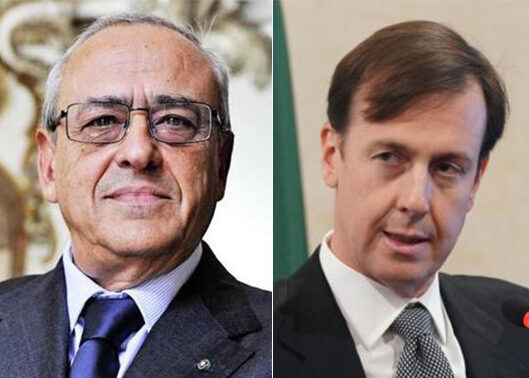
ANALYSIS / ITALIAN FINANCE
From his entry into the Sienese bank to a 12% stake, to the torpedo against Lovaglio: a reconstruction of how the Roman entrepreneur built his presence at the heart of Italian finance, with Fabrizio Palermo as his trusted technical profile.
6 March 2026 — Sources: Consob filings, Il Sole 24 Ore, Il Fatto Quotidiano, MilanoFinanza, Startmag, La Notte Online, Gazzetta di Siena
In November 2024, the Ministry of Economy and Finance sold 15% of Banca Monte dei Paschi di Siena on the market. Among the buyers were Banco BPM, the Del Vecchio family’s holding company Delfin, and — with a 3.5% stake — the group linked to Roman entrepreneur and property developer Francesco Gaetano Caltagirone. This was the moment when Caltagirone — already a significant shareholder in Generali and Mediobanca — returned to the Sienese bank of which he had been vice-chairman until 2012. From that point, his presence in the capital of Rocca Salimbeni has done nothing but grow.
A systematic ascent
The Consob filings tell a precise sequence of events. On 26 November 2024, through ten holding companies within his corporate galaxy, Caltagirone brought his stake to 5.02%. In February 2025, in the midst of the debate over MPS’s public exchange offer for Mediobanca, he rose to 8%. In February 2026 he reached 11.45%, subsequently settling at 12.26% following the completion of the Mediobanca operation — in which MPS acquired over 86% of the capital of Piazzetta Cuccia.
Today Caltagirone is MPS’s second-largest shareholder, behind Delfin which holds 20.949%. The European Central Bank has already authorised the entrepreneur to rise to 20%: a threshold which, in the banking system, marks the line between a significant shareholder and a controlling one.
The role of Fabrizio Palermo
One name recurs consistently throughout this strategy: Fabrizio Palermo, an Umbrian manager born in Perugia in 1971, who graduated with honours in Economics from La Sapienza in Rome, and built his career at Morgan Stanley in London, McKinsey, Fincantieri — where he served as CFO and Deputy Director General from 2005 to 2014 — and Cassa Depositi e Prestiti, of which he was CFO from 2014 and then CEO from 2018 to 2021.
His documented connection with Caltagirone dates to 2022, on two fronts. The first is Acea, the Roman multi-utility controlled by the City of Rome and partly owned by Caltagirone: Palermo became its CEO in September 2022. The second is the battle for control of Assicurazioni Generali. Caltagirone — alongside Delfin, in the so-called shareholders’ pact group — opposed the slate put forward by the outgoing board backed by Mediobanca. In that context, Palermo drafted the alternative industrial plan entitled Awakening The Lion, with which the pact shareholders challenged the continuity of CEO Philippe Donnet. That assembly battle was lost, but Palermo joined the Generali board of directors as a representative of the Caltagirone minority, a role he has retained.
In 2025, ahead of the renewal of Generali’s board, Caltagirone submitted a minority slate of six names. Palermo appeared in third place, after Flavio Cattaneo and Marina Brogi, who had both been directors since 2022. He was elected and confirmed on the board of the Lion of Trieste.
The torpedo against Lovaglio and the candidacy at MPS
The most recent chapter concerns MPS. On 4 March 2026 it emerged that the bank’s nominations committee had excluded CEO Luigi Lovaglio from the list of twenty candidates to be put before the shareholders’ meeting of 15 April, convened to renew the board of directors.
Lovaglio, appointed in 2022 with the support of the Treasury during the Draghi government, had led the bank’s turnaround and then the takeover of Mediobanca. But his relationship with Caltagirone had never been easy. Lovaglio himself, on the sidelines of an industrial plan presentation, had hinted at the situation with a remark reported by the newspapers: “Only one shareholder doesn’t want me, because I haven’t proved obedient.” The reference, according to journalistic reconstructions, was to the Caltagirone group.
The nominations committee justified its decision by citing the need to preserve the bank’s image and stability, including in relation to the Milan Prosecutor’s Office investigation into an alleged concert between Delfin and Caltagirone in the Mediobanca takeover — an ongoing investigation yet to be established before the competent authorities, which has also involved Lovaglio. The MEF, a shareholder with over 11% of the capital, did not openly defend the outgoing CEO’s reappointment.
Among the three profiles cited as possible candidates for the bank’s operational leadership — the others being Corrado Passera and Carlo Vivaldi — Palermo is described by financial sources as the candidate favoured by Caltagirone. The connection is direct: Palermo is currently CEO of Acea, a company in which Caltagirone has a stake; he sits on the Generali board in Caltagirone’s quota; and according to Il Fatto Quotidiano and Startmag, he is regarded as the Roman entrepreneur’s trusted man in the planned restructuring of the Sienese bank. The final decision will rest with the shareholders’ meeting and, subsequently, with the new board of directors.
A systemic design
Read in sequence, the trajectory appears coherent: Caltagirone has built over the years a trusted technical profile — Palermo — whom he has progressively positioned at the key nodes of Italian capitalism. First at Acea, then on the Generali board, and now potentially at the helm of MPS, the bank which — following the acquisition of Mediobanca — indirectly controls 13% of the Lion of Trieste.
The Financial Times, cited by InsideOver in January 2026, had already observed that the strengthening of the MPS-Mediobanca-Generali pole followed a systemic logic in which private interests and government direction move in parallel, without this necessarily implying formal agreements or collusion: it is the ordinary structure of Italian relational capitalism, with its web of cross-shareholdings and long-consolidated loyalties.
What the public sources document with certainty is simpler: a private entrepreneur has acquired, in little more than a year, a position as second-largest shareholder in a systemic bank; has placed his representative on the boards of the leading Italian financial institutions; and is now seeking to install his own candidate at the operational helm of Rocca Salimbeni. All of it accomplished through Consob filings, shareholders’ meetings, and board resolutions. In form, entirely regular. In substance, one of the most significant repositioning operations in Italian finance in recent years.
Sources consulted: Consob filings on significant stakes in MPS (2024–2026) • Il Sole 24 Ore • Il Fatto Quotidiano • Startmag • MilanoFinanza • Gazzetta di Siena • La Notte Online • InsideOver • Money.it • Tag43 • Wikiceo, TopManagers