
La nomina mancata e il nuovo scenario per il Santa Maria della Scala
19 Febbraio 2026
La fatica di Sisifo sul Colle
20 Febbraio 2026Piancastagnaio nel Quattrocento: da confine a comunità strutturata. Piancastagnaio in the Fifteenth Century: From Borderland to Structured Community
Dopo aver scritto della Madonna del Tribio, mettendo in fila alcune date, mi è venuta voglia di approfondire — senza alcuna pretesa di completezza, così, come un divertissement.
Piancastagnaio nel Quattrocento: da confine a comunità strutturata
Parte prima: L’acquisizione senese e la costruzione dell’ordine
Il Quattrocento è il secolo in cui Piancastagnaio smette di essere una posta in gioco e comincia a essere un luogo. Prima di quel secolo, la storia pianese è una storia subita: il castello passa di mano in mano — Aldobrandeschi, Orvieto, Siena, di nuovo contesa — senza che nessuno dei contendenti si preoccupi davvero di radicarsi. Il borgo sul crinale dell’Amiata conta per quello che controlla, non per quello che è. Nel Quattrocento cambia qualcosa di più profondo: cambia la domanda che il potere rivolge al territorio. Non più “a chi appartiene?” ma “come si governa?”.
La storia non comincia con un atto solo. Viene da più lontano, e si fa per gradi. Nel 1345 i senesi abbattono le mura e occupano la rocca. Ma il controllo rimane incerto, conteso per decenni con gli Orsini di Pitigliano e con le ambizioni orvietane. Solo tra il 1415 e il 1430 Siena riesce a consolidare definitivamente il possesso, incorporando Piancastagnaio nel Capitanato di Radicofani. È un processo, non un atto unico: e questo cambia il modo in cui vanno letti gli eventi successivi. Non si governa un territorio conquistato per gradi senza dotarlo, anche per gradi, di strumenti, presidi, uomini di fiducia.
Il primo strumento arriva subito. Nel 1416 un podestà inviato dalla Procura della Repubblica Senese, in collaborazione con alcuni uomini del paese, redige i primi statuti. Non è una formalità. Uno Statuto quattrocentesco è la fotografia di una società organizzata: norme sui mestieri, sul mercato, sull’ordine pubblico, sui rapporti con il potere centrale. La sua stesura in quel momento specifico segnala l’intenzione senese di radicarsi, non di transitare. Nello stesso anno iniziano le opere di consolidamento della Rocca Aldobrandesca, quasi a marcare visivamente il cambio di regime. Il messaggio è doppio: si scrive la legge, si rinforza il muro. La comunità pianese riceve in un colpo solo il codice e la pietra.
Negli anni Venti si consolida il presidio. Le carte parlano di casseri, munizionamenti, riparazioni, pagamenti per armamenti. Compare la figura di Valdambrino, nominato castellano: è il segno della volontà senese di affidare la custodia della rocca a uomini di fiducia. La presenza stabile di un castellano non è un titolo onorifico. Implica spesa pubblica continuativa, controllo delle mura, sorveglianza del territorio circostante. È un’amministrazione che respira ogni giorno.
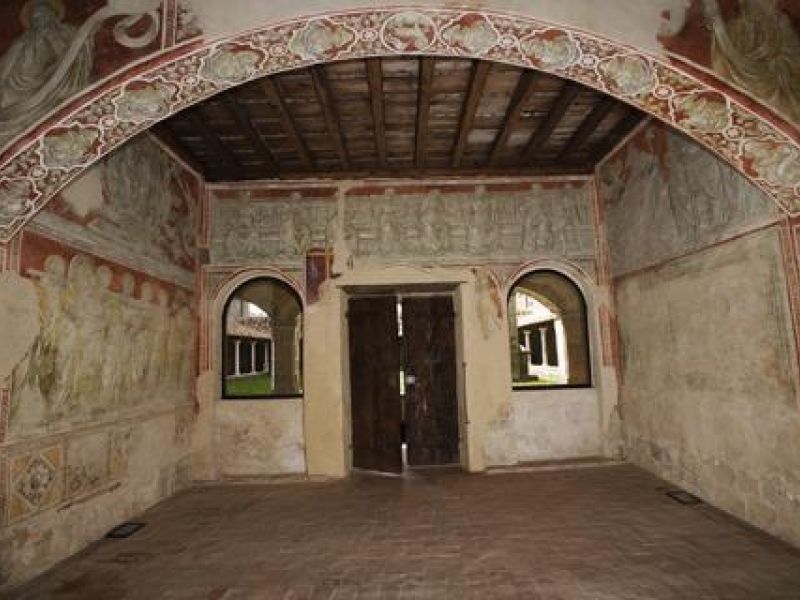
Nel 1424 si completa il lungo cantiere del convento di San Bartolomeo. Il complesso, fondato dal vescovo di Sovana alla fine del Duecento, giunge alla sua configurazione definitiva dopo un processo secolare. I francescani si radicano dove c’è una comunità capace di sostenerli: il completamento della fabbrica indica maturazione economica e demografica, certo, ma dice anche qualcosa di meno misurabile. Dice che la comunità pianese comincia ad avere una forma riconoscibile, un luogo in cui pregare i propri morti, un chiostro in cui accogliere i viandanti, una sala capitolare in cui fare le cose serie della vita religiosa. Affreschi quattrocenteschi riemersi durante i restauri recenti confermano che non si trattava di un cantiere periferico: qualcuno ci teneva che fosse bello.
Piancastagnaio in the Fifteenth Century: From Borderland to Structured Community
After writing about the Madonna del Tribio and lining up a few dates, I felt the urge to look a little deeper — with no claim to completeness, simply as a divertissement.
Piancastagnaio in the Fifteenth Century: From Borderland to Structured Community
Part One: The Sienese Acquisition and the Construction of Order
The fifteenth century is the century in which Piancastagnaio ceases to be a stake in a contest and begins to become a place. Before that century, the history of the town is a history endured: the castle passes from hand to hand — the Aldobrandeschi, Orvieto, Siena, then contested again — without any of the contenders truly caring to put down roots. The village on the ridge of Mount Amiata matters for what it controls, not for what it is. In the fifteenth century, something deeper changes: the very question that power addresses to the territory changes. No longer “who does it belong to?” but “how is it to be governed?”
The story does not begin with a single act. It comes from further back and unfolds gradually. In 1345 the Sienese tear down the walls and occupy the fortress. Yet control remains uncertain, contested for decades with the Orsini of Pitigliano and with Orvieto’s ambitions. Only between 1415 and 1430 does Siena finally consolidate its possession, incorporating Piancastagnaio into the Captaincy of Radicofani. It is a process, not a single decisive act — and this changes the way subsequent events must be read. One does not govern a territory conquered step by step without equipping it, also step by step, with instruments, garrisons, and trusted men.
The first instrument arrives immediately. In 1416 a podestà sent by the Prosecutor’s Office of the Sienese Republic, working together with several local men, drafts the first statutes. This is no mere formality. A fifteenth-century statute is a snapshot of an organized society: rules governing trades, the market, public order, and relations with central authority. Its drafting at that specific moment signals Siena’s intention to take root, not merely to pass through. In the same year, work begins to reinforce the Aldobrandesca Fortress, almost as if to mark visually the change of regime. The message is double: the law is written, the walls are strengthened. The people of Piancastagnaio receive, in a single stroke, both code and stone.
In the 1420s the garrison is consolidated. The records speak of keeps, munitions, repairs, payments for arms. The figure of Valdambrino appears, appointed castellan: a sign of Siena’s will to entrust the custody of the fortress to loyal men. The stable presence of a castellan is not an honorary title. It implies continuous public expenditure, oversight of the walls, surveillance of the surrounding territory. It is an administration that breathes every day.
In 1424 the long construction of the convent of San Bartolomeo is completed. The complex, founded by the bishop of Sovana at the end of the thirteenth century, reaches its definitive configuration after a centuries-long process. The Franciscans put down roots where there is a community capable of sustaining them: the completion of the building indicates economic and demographic maturation, certainly, but it also says something less measurable. It says that the people of Piancastagnaio begin to take on a recognizable form — a place to pray for their dead, a cloister in which to welcome travelers, a chapter hall in which to conduct the serious matters of religious life. Fifteenth-century frescoes that re-emerged during recent restorations confirm that this was no peripheral site: someone cared that it should be beautiful.