A muso duro
28 Marzo 2026
La rappresentazione che cede
29 Marzo 2026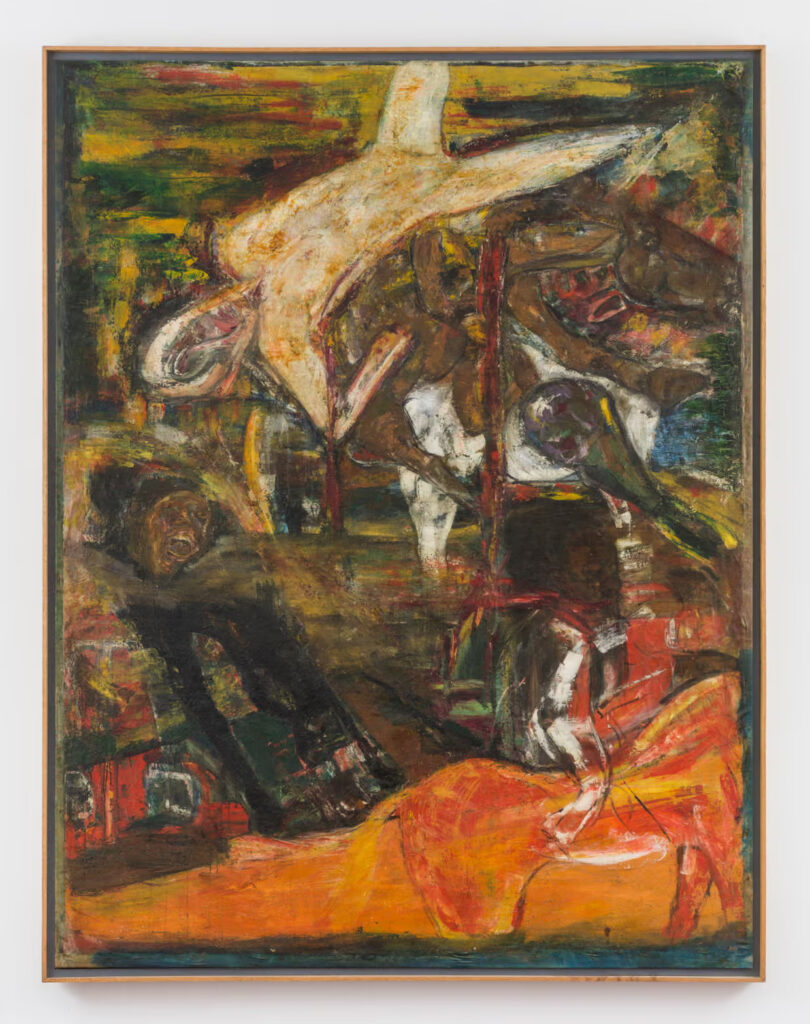
There are weeks when the gallery listings read like a manifesto against the narrowness of the Western canon, and this is one of them. Four exhibitions, running more or less concurrently across London and Cambridge, make a collective argument that the history of form — of mark-making, of surface, of the object — is vastly older, stranger, and more various than any single tradition can contain.
Start at Pitzhanger Manor, where Phoebe Collings-James has turned ceramics into a kind of body armour — literally, in some cases, and conceptually throughout. Her work pulls on cuneiform writing and Ashanti folklore with the confidence of someone who knows that both predate the canon that ignored them, pressing these references into clay with a political intelligence that never tips into didacticism. The pieces have weight in both senses: you feel the material and you feel the argument.
A short tube ride away, the Whitechapel is doing full justice to Veronica Ryan with a survey of over a hundred works. Ryan won the Turner Prize and the event was treated, in some quarters, as a discovery. It wasn’t — she had been making her quietly extraordinary ultra-conceptual sculpture for decades, finding in ordinary organic matter (seed pods, shells, the soft architecture of things that protect other things) a vocabulary of displacement, memory, and the body’s negotiation with the world. A show this size allows you to see the full grammar of it.
Cambridge offers a different kind of reckoning. Frank Bowling’s mini-retrospective at the Fitzwilliam traces the arc from early figuration — work that registered the post-Windrush moment with uncomfortable directness — through to the stained, poured, luminous abstractions that made him a singular figure in the story of twentieth-century painting. The journey matters. Understanding where Bowling began makes the sublime he eventually reached feel hard-won rather than effortless.
And at Edel Assanti, three Papunya Tula artists — Lorna Ward Napanangka, Yukultji Napangati, John West Tjupurrula — remind anyone who needs reminding that abstraction did not begin in Manhattan, or Paris, or anywhere in Europe at all. The dizzying, hypnotic patterning of Western Desert painting carries ancient cosmological knowledge inside its formal structures; what looks to an uninitiated eye like pure geometry is, in fact, an extraordinarily precise map of country, story, and law. To call it merely “abstract” is to mistake the vehicle for the cargo.
Taken together, these four shows don’t share a curator, an institution, or an aesthetic. What they share is a refusal to treat the art-historical mainstream as the only water worth drinking. That is, quietly, the most radical position a gallery can take.