Il primo maggio dei cinque misteri
2 Maggio 2026
C’è un cadavere sulla spiaggia E il potere trema
2 Maggio 2026The Classroom and the Favela: Two Stories About What Belongs to Whom
There is a question that cuts across cultures, continents, and centuries, and it surfaces in two very different places this spring. One is a favela clinging to the hills of Rio de Janeiro in 1996. The other is a primary school classroom in Senegal in 2026. The question is the same: who owns the language? And its corollary: who owns the story?
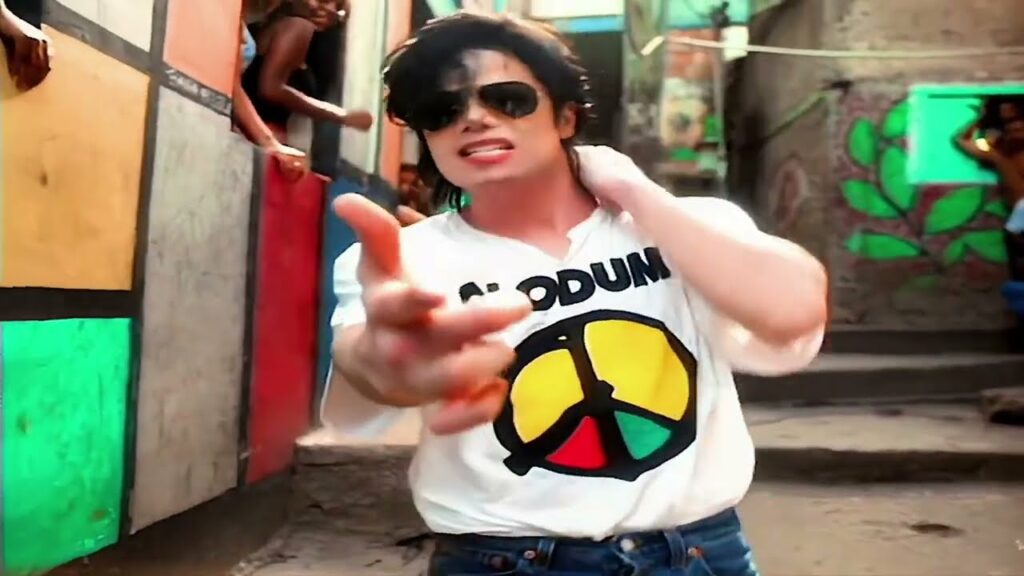
Start with Brazil. In 1996, Michael Jackson and Spike Lee made one of the riskiest and most unforgettable videos of the decade. They took They Don’t Care About Us, one of Jackson’s angriest and most confrontational songs, and filmed it in Brazil amid official outrage, legal battles, and reports that the production had to negotiate with drug traffickers to gain permission to film in the Santa Marta favela. Brazilian officials were horrified. Rio was trying to polish its global image while pursuing the 2004 Olympics, and the idea of Michael Jackson filming in one of the city’s poorest communities hit nerves immediately. Officials feared the video would show the world a Brazil of poverty, race, neglect, and exclusion instead of beaches and a skyline. Latin TimesLatin Times
They were right to be afraid — and wrong about what they feared. What the video revealed was not the embarrassment of a nation, but the deeper embarrassment of a state that had made the poor invisible. Jackson placed the song in Salvador’s Pelourinho, a historic neighborhood named for the whipping post where enslaved Africans were publicly beaten, performing alongside Olodum, the Afro-Brazilian percussion and cultural group deeply associated with Black pride and the musical style known as samba-reggae. The body moving through those streets was not an American pop star doing poverty tourism. It was an act of deliberate mapping: African American pain superimposed on the geography of the African diaspora in the Americas. Less than a day after Jackson’s death, the mayor of Rio de Janeiro announced that the city would erect a statue of the singer in Dona Marta, a favela that was once notorious for drug dealing and had since become a model for social development. Latin TimesMJJCommunity
Language, like a favela, is a territory. It can be occupied, cleared, policed, or reclaimed.
Now move to Senegal. Since its independence in 1960, Senegal has retained a public education system modeled after the French colonial one. French remains the only permitted language of instruction in most public school classrooms, even though outside of the urban elite most children enter first grade knowing only a few words of French. At least one-third will not finish primary school. africasacountry
Bilingual programs introducing instruction in local languages — Wolof, Sereer, Pulaar — alongside French have consistently demonstrated remarkable improvements in student competency in all subjects, including French itself. And yet skepticism persists. Parents ask: how will learning to read in the language they speak at home help our children? Teachers ask: do vernacular languages have the capacity to mediate scientific concepts? Beneath these reasonable-sounding questions lies something less reasonable: a colonial residue, the automatic assumption that some languages think and others merely speak. africasacountry
The transition to bilingualism has been further complicated this year by the cancellation of USAID funding. Every new pedagogical manual came stamped with the logo of an aid organization, making clear that public education reforms were ultimately tied to the interests of foreign partners. Even the effort to reclaim linguistic sovereignty was funded from outside — which means it could be unfunded from outside too. Decolonization, in this light, looks less like a revolution and more like a loan with conditions. africasacountry
And yet officials at Senegal’s Ministry of Education, when pressed, are not discouraged. Bilingual education has by now become “a state affair,” they declare, and is at this point “irreversible.” There is something almost defiant in that word — irreversible — spoken inside a ministry where so much remains reversible, contingent, debt-dependent. africasacountry
What connects the favela of Rio and the classrooms of Dakar is not geography but structure. In both cases, a dominant power — the Brazilian state, the French empire — decided that certain people’s lives, languages, and stories did not belong to them. In both cases, the act of reclamation was treated as a provocation. Jackson arriving by helicopter in Santa Marta was as scandalous to Rio’s authorities as a Wolof dictation is laughable to a French-educated school director who smiles, imagining all the mistakes he would make in his own mother tongue.
A younger man learning to write in Wolof through a mobile application described the experience as restoring some part of himself, rediscovering things he felt he already knew. When he realized that the way he had spelled his own name throughout his life had distorted its proper pronunciation, there was a touch of anger as well. africasacountry
That anger is not a problem. It is the beginning of an answer.