La rappresentazione che cede
29 Marzo 2026
Storia di Soraya: arte per la libertà
29 Marzo 2026The Trap of the Eternal Embrace: Nollywood, the British Museum, and the Aesthetics of Captivity
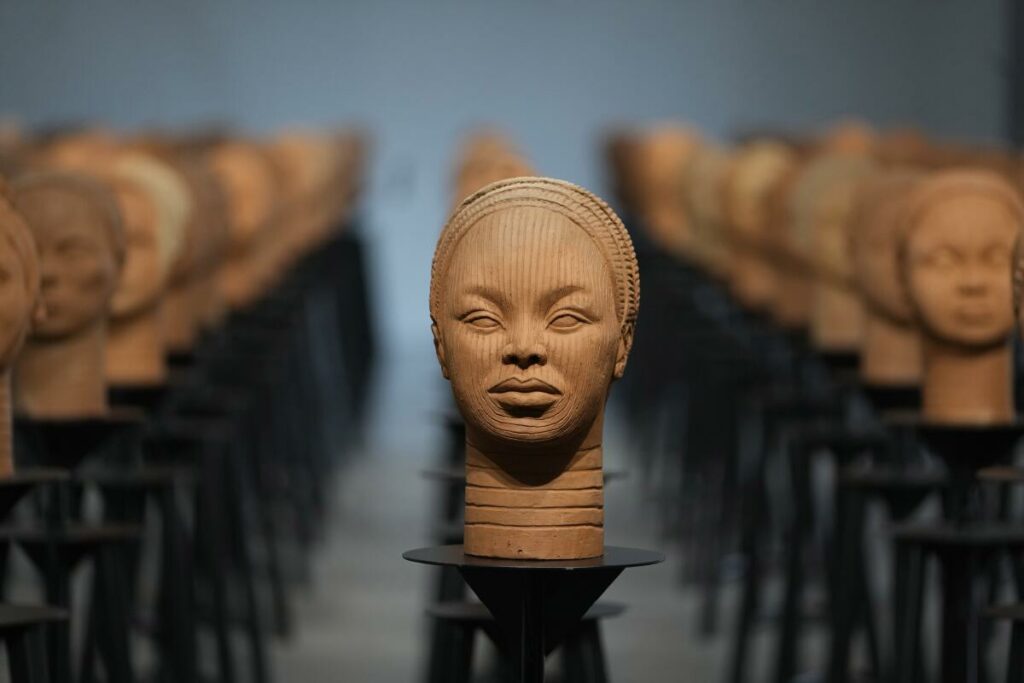
There is a peculiar geometry to captivity. It does not always announce itself with bars or chains. Sometimes it arrives dressed as romance. Sometimes it arrives dressed as reverence.
Two cultural events, separated by geography and medium, converge on the same uncomfortable question: who controls the narrative frame, and what does that frame cost the people inside it?
Nollywood’s Romance Problem
Nigeria’s film industry produces more titles per year than Hollywood and Bollywood combined. It has survived without studio infrastructure, without reliable electricity grids, without distribution networks worthy of the name. It invented itself through sheer improvisational force, and for two decades it was one of the most genuinely autonomous cultural industries in the world — made by Africans, for Africans, about African life, answerable to no foreign gaze.
And yet. Open any streaming platform today and Nollywood’s dominant export genre is the romantic comedy: the rich Lagos bachelor, the stubborn independent woman, the inevitable reconciliation. Clean lighting. Tailored suits. Lekki penthouses with infinity pools reflecting a skyline that could be anywhere. The texture of Nigerian life — its noise, its fury, its philosophical density, its theological complexity — sanded down into a product that travels well.
The romance genre is not innocent. It is, in the tradition that runs from Hollywood’s golden age through the Bollywood masala era, a technology of aspiration management. It teaches audiences to redirect social frustration into private longing. The problem is not resolved; the problem is eroticised. The broken system becomes a backdrop for personal triumph. The couple escapes into the penthouse. The city remains below, unreformed.
Nollywood’s founders — the generation of Kenneth Nnebue and the early straight-to-video boom — made films of extraordinary rawness. Living in Bondage was not a romance. It was a horror film about the cost of modernity, about what Lagos demanded in exchange for success. The juju, the sacrifice, the haunting: these were not superstition but sociology, dressed in the only genre that could hold them. That cinema was genuinely dangerous. It said something.
The turn toward romance is not simply a market choice. It is a political choice, though rarely acknowledged as such. The romantic comedy is the genre that Diaspora money is most comfortable funding, that international co-production structures most easily absorb, that Western streaming platforms most reliably greenlight. The penthouse couple is universally legible. The ritual horror, the political allegory, the dense vernacular comedy of Lagos bus conductors — these require a viewer who already inhabits the culture. The romance requires only a viewer who has ever wanted something they couldn’t have.
What is lost in translation is precisely what made Nollywood worth translating.
The British Museum’s Hawaiian Problem
The British Museum has mounted an exhibition on Hawaii. The timing is interesting. The institution has spent several years under sustained pressure over its retention of the Elgin Marbles, the Benin Bronzes, the Rosetta Stone — objects whose presence in Bloomsbury represents not acquisition but extraction, not preservation but possession.
The Hawaiian exhibition arrives, then, into a particular atmosphere. The British Museum has become, despite itself, a theatre in which the ethics of collection are staged nightly for visitors who may not realise they are watching a philosophical argument as much as an aesthetic display.
Hawaii presents the museum with a specific set of problems. The islands have their own deep relationship to extraction — of sandalwood, of labour, of sovereignty, of cultural objects, of land — administered over two centuries first by traders, then by missionaries, then by American sugar interests, then by formal annexation. Hawaiian material culture in European and American museum collections did not arrive through neutral channels. The feathered cloaks, the sacred objects, the genealogical artefacts: each carries a history that the exhibition’s curatorial choices must either acknowledge or suppress.
The London Review of Books, where this exhibition was reviewed, is precisely the organ one consults when one wants to know whether a cultural institution has taken its own premises seriously. The review’s scepticism is, in this context, a form of intellectual hygiene.
What is at stake in the British Museum’s Hawaiian gallery is not simply the question of repatriation, though that question hangs over every display case. It is the more fundamental question of what a museum does to the objects it contains. The museum transforms the sacred into the aesthetic, the functional into the archival, the living into the historical. It does not merely house objects; it reclassifies them. A Hawaiian feather cloak in a case is no longer a cloak worn by a chief in a ceremony of living political consequence. It is evidence of a civilisation the museum implicitly frames as past.
The frame is the argument.
What Connects Them
Nollywood trapped in the romance genre. Hawaiian objects trapped in the display case. The connection is not metaphorical but structural.
Both represent the operation of what one might call aesthetic captivity: the process by which a culture’s most disruptive, most specific, most ontologically charged expressions are converted into forms that are manageable, marketable, universally legible — and therefore stripped of precisely the qualities that made them significant.
The romantic comedy manages Nollywood the way the museum manages the feather cloak. It does not destroy; it preserves, which is a subtler form of neutralisation. The industry survives; the city below the penthouse remains unreformed. The cloak endures behind glass; the political claim it embodies remains unaddressed.
In both cases, the frame presents itself as neutral, even generous. The streaming platform is giving Nollywood global reach. The museum is giving Hawaii global visibility. What neither frame acknowledges is that reach and visibility, on these terms, require a prior act of translation — and that translation always has a cost, always extracts something, always leaves behind the parts that didn’t make it through.
The parts that didn’t make it through are usually the most important parts.
What Nollywood needs is not more romance. It needs the conditions under which Living in Bondage became possible: a captive audience with no alternative, a filmmaker with nothing to lose, a genre flexible enough to hold genuine terror. What Hawaiian culture needs from the British Museum is not an exhibition but an answer — which is to say, an act rather than a display.
Until then, we are left with the aesthetics of captivity: beautiful, well-lit, travelling well, and costing precisely as much as it appears to cost nothing.