MPS. Gli azionisti hanno detto no al ribaltone
16 Aprile 2026
La miniera del Siele e i Nathan. Un’impresa ebraica nel cuore del Risorgimento
16 Aprile 2026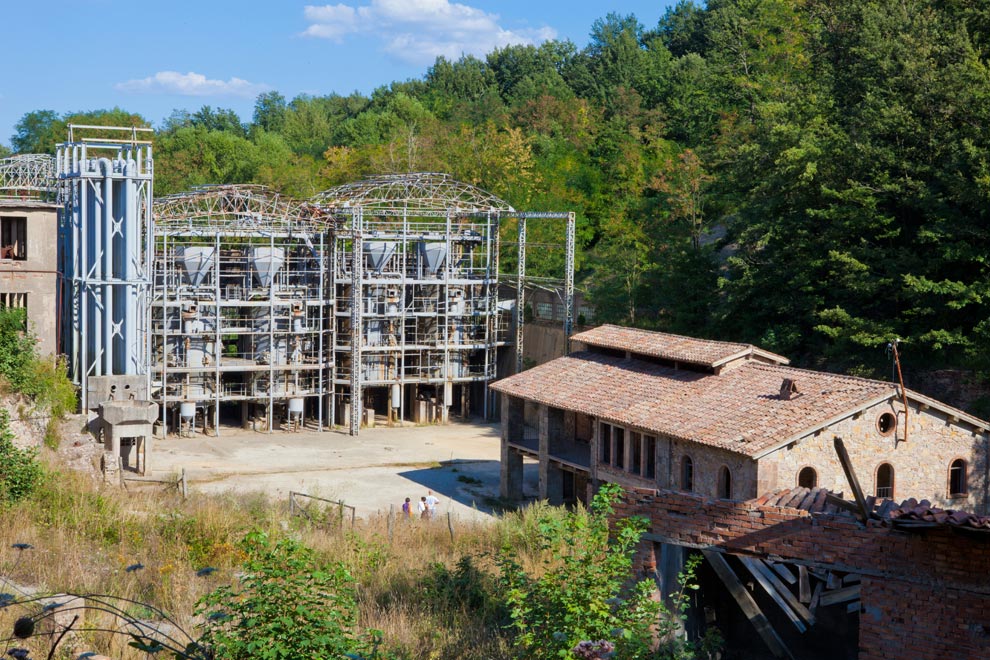
I. The Red Stone and Its Owners
There is a place where the deepest history of Italy has settled into the body of the earth. It is called Siele — a gorge among the forests of Piancastagnaio — and for over seventy years it extracted from the subsoil not only mercury but something far beyond: proof that entrepreneurship, civic vision, and ethical conscience can coincide. That this coincidence can bear a family name. A woman’s name, to be precise. But we shall get there.
In 1841, a shepherd named Domenico Conti, known as Mecone, while grazing his sheep in the locality of Diaccialetto, was struck by pieces of cinnabar in the bed of the Siele stream and decided to sell them as pigment to the pharmacist of Pitigliano, a member of the local Jewish community. The pharmacist had them examined by Cesare Sadun, an important Jewish merchant, brother-in-law of the brothers Angelo and Salomone Modigliani of Livorno, who had long been engaged in the trade of mercury extracted from the Spanish mine of Almadén. From a red stone picked up in a stream, one of the most singular stories of Italian capitalism and patriotism in the nineteenth century begins.
The Modiglianis and Sadun established on 5 December 1846 in Livorno, with a capital of 80,000 lire, the “Società Industriale Stabilimento Mineralogico Modigliani.” The enterprise struggled, failed, and in 1865 Emanuele Rosselli, a prosperous Livornese merchant, purchased the establishment at auction from the Livorno tribunal. From that moment, for over seventy years, the Siele belonged to the Rossellis and the Nathans.
With the establishment in 1867 of the firm “Angelo Rosselli” and the entry into the partnership of Sara Levi Nathan — widow of a wealthy London banker and a significant figure of the Italian Risorgimento through her connections with Giuseppe Mazzini — the mine’s true productive takeoff began. It was not merely an injection of capital. It was the arrival of a presence that brought with it something more than money: a network, a vision, an authority built over decades of clandestine political work that official history has preferred not to see, or does not know how to tell.
The Rosselli-Nathan mine experienced in the following years a remarkable productive surge: the construction of the new Cermak-Spirek furnaces, the introduction of the steam engine, the discovery of a rich cinnabar seam at the Solforate, and the strong rise of mercury prices on international markets gave decisive impetus to the establishment’s development, with employment surpassing three hundred workers in the early years of the twentieth century. It was not merely a company: it was a self-sufficient village, with housing for technicians, an elementary school, a chapel, a company store, an infirmary, a post office. The mine organised life, not only labour. Among the Rossellis who directly managed the establishment, the name of Raffaello remains inscribed in the rock in a literal sense: the deepest shaft in the entire mine, three hundred and fifty metres below the surface, still bears his name. Raffaello also wrote, in 1890, a technical memoir on the mine for the Proceedings of the Tuscan Society of Natural Sciences: the owner who studies what he possesses, who looks at cinnabar with scientific eyes as well as entrepreneurial ones.
But to truly understand what the Siele was, and what the Rossellis and the Nathans were in the Italy that was building itself, we must pause on the woman who entered the partnership in 1867 bringing her capital and her history. We must pause on Sara. Because Sara Levi Nathan was not the widow of a banker. She was one of the invisible architects of Italian Unification.
II. The Houses That Made Italy
Historians of the Risorgimento tend to work in monuments: Mazzini, Garibaldi, Cavour, Victor Emmanuel. The real history — that of the infrastructure, the financing, the clandestine networks, the houses where insurrections were plotted and manuscripts kept safe — is almost always the history of women rendered invisible by the grammar of masculine grandeur. Sara Levi Nathan is one of these women. Perhaps the most important among those who do not appear in textbooks.
Sara Levi Nathan was born in Pesaro on 7 December 1819. At eleven she lost her mother. To preserve her Jewish faith she was sent to relatives in Livorno, a city that guaranteed a certain freedom of worship. There she met her future husband Moses Nathan, a Frankfurt banker, and followed him to London, where she gave birth to twelve children and opened the doors of her home to Italian patriots in exile. The Nathan household in London was already, in the 1840s, a political place before it was a domestic one.
The first documented epistolary contacts with Giuseppe Mazzini date to 1848. Over time Sara Levi became one of Mazzini’s most assiduous correspondents and, in the final years of his life, the sole confidante of the republican leader’s outpourings and plans — including those for armed struggle. She was not a simple admirer, nor a sentimental benefactress. She was the operational node of a network that needed money, safe houses, women capable of keeping a secret and a bank account at the same time. Through her passed the financing that the Party of Action, and later the Universal Republican Alliance, directed towards the purchase of arms and the promotion of insurrectionary activities.
Her houses were political institutions in domestic form. A sequence of places — London, Florence, Milan, Lugano — that the police of the various pre-unification states kept under surveillance and that therefore demanded constant movement. When the Roman Republic fell in 1849 and Mazzini returned to London, he took refuge with the Nathans, whose home became the point of reference for Mazzinians and democrats in England more broadly. Sara chose as tutor to her children Maurizio Quadrio, one of Mazzini’s most trusted collaborators: political formation and family formation had to be the same thing, inseparable. It was at her villa in Lugano — La Tanzina, purchased in 1865 to escape arrest — that Mazzini drew up plans for the insurrectionary attempts of 1869 in northern Italy. La Tanzina hosted Carlo Cattaneo, Agostino Bertani, Nino Bixio, Federico Campanella: not a bourgeois residence, but a clandestine political circle with a roof and a garden. Carlo Cattaneo died in Lugano in the Nathan home. Mazzini died in 1872 in Pisa, in the house of Giannetta — Sara’s daughter, wife of Pellegrino Rosselli — the name that unites the two families even in that final act.
And Garibaldi? Sara had a direct, passionate, politically urgent relationship with him — that of someone who knows that between the two great men of the Risorgimento there is a fracture that could undo everything, and that it must be repaired. On 19 August 1862, from Lugano, Sara launched a direct appeal to Garibaldi: “The Fatherland is saved if the two men whom Italy loves and esteems above all others are united.” The letter survives. It is one of the most lucid documents of Risorgimento politics: a woman writing to Garibaldi to tell him that the division with Mazzini is the true danger, at the very moment when Piedmontese forces were preparing to stop him at Aspromonte. The appeal went unheeded. But the gesture says everything about Sara’s authority: she did not ask, she intervened. She did not plead, she argued. She dealt with Garibaldi as an equal, because she felt herself to be one, and had every reason to.
When Mazzini died, Sara was at his bedside. At the funeral she attended to the coffin alongside the wife of Aurelio Saffi, and asked that the body not be embalmed — a request that was ignored. Even in that final moment, Sara wanted to decide. And even in that final moment she was overruled. The history of women is also this: to be present at every decisive moment, and then to disappear from the narration of that moment.
But what followed could not be ignored. Sara became the driving force behind the publication of Mazzini’s writings, overseeing the national edition of his works and the donation of over 4,500 autographs, which eventually came to rest in the Library of the Risorgimento in Rome. She purchased all the manuscripts, all the publishing rights, and organised the transmission to posterity of the entire corpus of Mazzinian thought. Without her, a considerable portion of that archive would probably have been dispersed. The Risorgimento we read about in books is also, to a degree we cannot calculate, the Risorgimento that Sara saved.
III. The Question of Women
There is, however, a dimension of Sara Levi Nathan that goes still further than the custodianship of another’s thought, extraordinary as that custodianship was. Sara had a political vision of her own — autonomous, which in certain respects anticipated by decades the public debate of her time: the question of female emancipation, and in particular of the poorest and most exposed women.
The emancipation of women, especially those of the lower classes, was a fundamental theme for Sara Levi Nathan throughout her life. Through philanthropic works she sought to educate the younger generation of women and spur them toward changing their condition. This was not philanthropy in the consolatory sense — not the charity that leaves intact the system that produces misery. It was systematic political action, working through education, organisation, and the construction of concrete alternatives.
When she moved to Rome in 1873, she founded in the Trastevere district an elementary school named after Mazzini, open to girls, and established the Unione Benefica — a house to prevent prostitution by offering indigent or vulnerable girls accommodation, means, and the possibility of work. The choice of Trastevere was not accidental: it was the popular quarter par excellence, the one farthest from the drawing rooms, the one where girls without education or income ended up in the system of state-regulated prostitution. In an Italy where the Cavour Law institutionalised the brothel trade, Sara committed herself to the abolitionist movement with the same energy as the political causes: women reduced to servitude were not a matter of public order — they were citizens to be emancipated. She fought for the abolition of state regulations on prostitution in support of her son Giuseppe, who had introduced the positions of Josephine Butler into Italy.
Josephine Butler was the great English reformer who in those same years was fighting the same battle in Britain: not the moralisation of customs, but the recognition that regulated prostitution was a form of legalised slavery, an instrument by which the state and the market together controlled the bodies of poor women. Sara had lived in London, knew that debate, and brought it to Italy with the same determination with which she had brought Mazzinian thought. The struggle for women and the struggle for the fatherland were, in her vision, two aspects of the same battle for human dignity.
She opened the Sala Mazzini, where from 1873 to 1882 lectures were held every Sunday on the work The Duties of Man. The Mazzinian title is significant: Sara read it through the lens of gender, as a call addressed to women too — indeed addressed above all to women, the great excluded from the citizenship of the new unified state. It was Giorgina Saffi and Jessie White Mario — another important figure of the Risorgimento, writer and biographer close to Mazzini and Garibaldi — who gave expression to this vision and coined the term madre cittadina, the citizen-mother. Not the mother who retreats into the private sphere, but the one who educates her children to public life because she herself is fully within public life. Sara was not a mother who devoted herself to politics despite her family. She was a figure in whom family and politics were the same thing, fused into a unified project of civic construction.
Before her death she had designated a bequest to the Commission for the dissemination of Mazzini’s writings. In 1917 the Scuola Mazzini was erected as a moral entity under the name Opera Pia Sarina Nathan. She died in London on 19 February 1882, alone, without informing anyone of her imminent passing. Even in that final gesture there is something that defines her entirely: she had no need of witnesses. She needed things to last. And she had ensured that they would. She left to those who came after her an archive, schools, a network, a charitable institution, and a son.
That son’s name was Ernesto.
IV. Ernesto Nathan, and 1938
Sara’s legacy did not dissipate. It was gathered above all by Ernesto — the fifth of the twelve children, raised in those houses where Mazzini had slept and Carlo Cattaneo had died, formed by a tutor chosen from among the most trusted collaborators of the father of the Risorgimento, educated in secularism and public ethics as one is educated in faith — with daily insistence, by domestic contagion. Ernesto Nathan could only become what he became. Jewish, secular, cosmopolitan, Mazzinian-republican: from 1907 to 1913 he led Rome with an administration that historians consider among the finest the capital has ever known.
He was the first mayor of Rome from outside the class of landowners and notables who had managed the city as a personal fief. And he demonstrated this immediately, in deeds and choices. In 1909 he approved the city’s first urban plan, which defined the areas to be developed outside the walls while acknowledging that 55% of buildable land was in the hands of just eight major proprietors. He promoted the municipalisation of the tram service and of electricity. He opened one hundred and fifty municipal nursery schools, equipped with canteens, workshops, gymnasiums, medical services, and libraries. He built public housing. He fought property speculation. He clashed with the Vatican with a frankness that earned him admiration and enemies in equal measure — the natural continuation of the secular anticlericalism breathed in the Nathan household since his London childhood, that same household where Mazzini had found refuge.
In Ernesto, with an almost moving consistency, Sara’s pedagogical design reached fulfilment. The mother had opened schools for the girls of Trastevere; the son opened one hundred and fifty nurseries for the children of Rome. The mother had fought speculation on the bodies of poor women; the son fought speculation on the land of the capital. The mother had kept Mazzini’s memory alive through the Sunday lectures of the Sala Mazzini; the son had donated to the state, in 1900, the entire collection of over 4,500 Mazzinian autographs that Sara had preserved for decades. The gesture closed a circle: Sara had saved the writings of the Risorgimento; Ernesto had returned them to the nation that Risorgimento had generated.
The same nation that, thirty-eight years later, would expropriate his heirs.
Because in 1938, 1938 arrived. The Rosselli-Nathan families, who for over seventy years had maintained full control of the Siele, were forced to relinquish the mine following the fascist racial laws. In 1939 the mine passed under the total control of the fascist hierarch Count Giovanni Armenise, majority shareholder of the Banca Nazionale dell’Agricoltura.
The substitution is exact in its crudeness. In the place of a family that had built something — a workers’ village, a productive enterprise, a network of schools, an archive of political thought, houses where Italy had made itself — came the fascist notability with its banking connections. It was not merely a change of ownership. It was the demonstration of what the racial laws were in their deepest economic substance: the systematic expropriation of Italian Jewish bourgeoisie — that very bourgeoisie which had financed the Risorgimento, preserved Mazzini’s writings, written to Garibaldi to keep him within the republican orbit, opened free schools in Trastevere, governed Rome by modernising it, extracted mercury from a Sienese mountain, and paid the wages of the miners of Piancastagnaio.
The workers continued to descend into the Raffaello shaft. Cinnabar continued to be extracted and distilled. But something had changed in the character of the place — something that the testimonies of the oldest miners, gathered by Marina Calloni’s research, return to us in fragments: the perception that the previous owners had not merely been employers.
They were right. They had not been. They had been bearers of an idea of Italy — secular, republican, capable of holding together the mercury of the Amiata and the autographs of Mazzini, the mine and the school, profit and justice, cinnabar and freedom — that fascism could not destroy even by expropriating it. Because the autographs had already been donated. They had already become the patrimony of everyone.
Sara Levi Nathan — born in Pesaro, Jewish, Mazzinian, financier of insurrections and of mines, editor of writings and guardian of clandestine houses, founder of schools and abolitionist, mother of Ernesto Nathan mayor of Rome — is one of those figures upon whom Italy has built itself without acknowledging her. One of those women without whom the Risorgimento would have had no legs, no roof, no treasury. A figure still awaiting her rightful place in the public memory of the country she helped to make.
Today the Raffaello shaft descends still three hundred and fifty metres beneath the forest of the Pigelleto. The Emilia gallery is open to visitors. The owners’ villa watches from above the entrance gate with its austere grace. But the story it holds — of a woman who held together Mazzini and Garibaldi, the writings of the Risorgimento and the accounts of a mercury mine, the struggle for women and the struggle for the fatherland — is still waiting to be told with all the seriousness it deserves.
Not as a historical curiosity. As a debt.