Caso David Rossi: la commissione parlamentare conclude per l’omicidio
7 Marzo 2026
Cinque finestre su un mondo che non si lascia nominare
8 Marzo 2026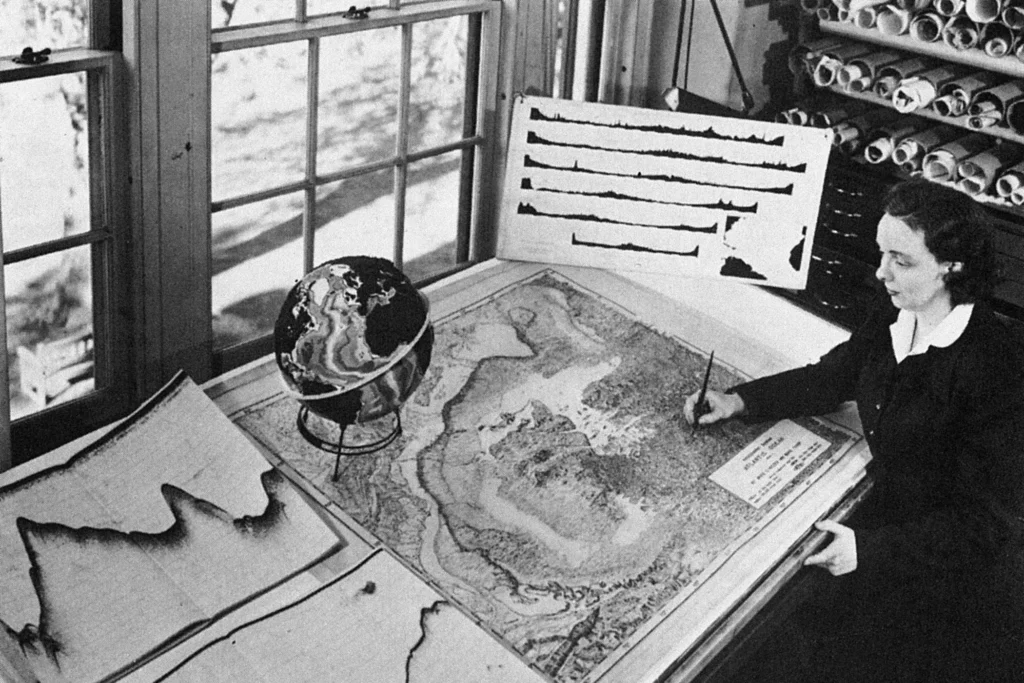
There is a posture that recurs across the three stories that have landed on my desk this week — a posture of working from the margins, from the shore, from the apartment block, from the desk to which one has been confined. It is not a posture of defeat. It is something more interesting, and more troubling: the posture of someone who has understood that the centre lies elsewhere, and has chosen, deliberately, to stay where they are and draw.
Marie Tharp was not allowed on the ships. While her colleague Bruce Heezen collected sonar data aboard research vessels, Tharp analysed it back at base, because women were barred from going onboard. Ada Lovelace Day From the halls of Columbia and sometimes her desk at home, she became an interpreter and artist, analysing sonar pings from vessels crisscrossing the ocean and scribing the data on canvas by hand. Smithsonian Ocean What she produced from that fixed, landlocked position was one of the most consequential acts of seeing in the history of science. She discovered a rift valley at the bottom of the North Atlantic — a feature so anomalous she kept re-checking her calculations. Smithsonian Magazine When she showed her findings to Heezen, he groaned and dismissed her interpretation as “girl talk.” Smithsonian Magazine It took seismic data — literally, the shaking of the earth — to prove her right. The floor of the ocean was not flat. It had a spine.
The idea that reality, looked at carefully enough and from a position of enforced stillness, will eventually reveal its hidden architecture — this is what connects Tharp to the Venezuelan artist Óscar Olivares, working in Zacamil, a working-class district on the outskirts of San Salvador. Using a rainbow of bottle caps in various sizes, Olivares built a mural thirteen metres high inspired simultaneously by Leonardo da Vinci and by the French pointillist Paul Signac. Infobae The result is a Latin American Mona Lisa — her face golden-toned, executed in red, orange and yellow caps, her jewellery, hairstyle and coloured dress evoking the graces of a modern Latin woman, while behind her, instead of da Vinci’s pastoral Italian countryside, rise vivid images of housing blocks, a resolute blue mountain and a chequered sky. Infobae She looks out over a neighbourhood that, as the artist himself notes, has undergone an enormous transformation in recent years Infobae — though one might add, under conditions that are themselves politically contested.
What strikes me about both works is the question of material. Tharp worked with sonar pings — sound waves sent into the dark and returned as numbers. Olivares works with bottle caps — the discarded closures of mass consumption, plastic waste collected by local residents and recyclers. In both cases, the material is humble, even despised. In both cases, it is redeemed by being looked at with sufficient patience and intelligence. The ocean floor was assumed to be featureless; the bottle cap is assumed to be garbage. Both assumptions turn out to conceal a world.
This is not merely an aesthetic observation. It is a political one. And it connects to the third story, the most urgent of the three.
İlker Çatak’s new film Yellow Letters — Gelbe Briefe — tells the story of an artist couple in Turkey who come under pressure from an authoritarian political system and must choose between their ideals and accommodation. Heinrich-Böll-Stiftung It won the Golden Bear at the Berlinale 2026 Heinrich-Böll-Stiftung, and has immediately been engulfed in a controversy that is itself a kind of live performance of the film’s themes: filmmakers using their acceptance speeches to make pro-Palestinian statements, politicians and parts of the German media pushing back, the culture ministry issuing recommendations to the festival, including the creation of a code of conduct. Variety Çatak responded without hesitation: “Anything else would constitute blatant state interference in the autonomous exercise of art. We would have to call it what it is: censorship.” Variety
What interested him, he said, was not reacting emotionally to authoritarian systems but understanding their mechanics — how power operates through pressure, silence, and the slow erosion of certainty. Arabianmoda The film traces what sticking to your ideals to their very tether looks like, until compromises have to be made and ideals give way to the exigencies of survival. High On Films
Here, then, is the thread that runs through all three. Tharp at her desk, barred from the ships, redrawing the charts Heezen told her to redo because the rift valley she had found was inconvenient. Olivares assembling his Gioconda from the waste that the neighbourhood itself had accumulated, cap by cap, in an act of communal reclamation. Çatak’s fictional couple losing their home, their jobs, their social existence — and the question the film circles without ever resolving: at what price do you keep your name? At what price do you surrender it?
Tharp herself left the answer in a line that feels, now, almost like a coat of arms: “I was so busy making maps I let them argue. I figured I’d show them a picture of where the rift valley was and where it pulled apart. There’s truth to the old cliché that a picture is worth a thousand words, and that seeing is believing.” Smithsonian Ocean
She was right. But one must also ask: who gets to see? Who controls the institutions through which seeing becomes official? Who decides that a woman’s meticulous data is “girl talk”, that a bottle cap is garbage, that a filmmaker’s acceptance speech is a political problem? The blank canvas is never truly blank. It is always bordered by power. What these three figures share is not merely talent or patience, but a refusal to accept that the borders are where they are told to be. The rift valley was there. The mural is there. The yellow letter has arrived.
The question is what you do with it.