Floramiata, torna il sereno. Un metodo condiviso per chiudere la vertenza
26 Marzo 2026
Mormorii — Francesco Carone alla Rocca Aldobrandesca di Piancastagnaio
26 Marzo 2026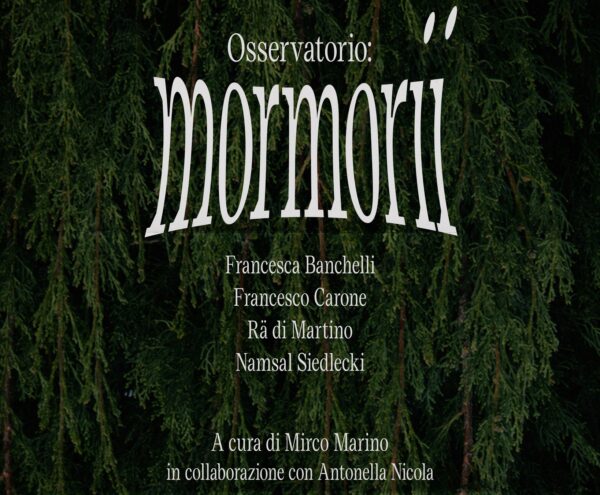
There is a gesture that precedes the exhibition. A golden crown, fragile, almost festive, resting among the branches of three cypress trees in front of the fortress walls. Those who arrive do not yet know they are entering something. And yet they are already inside.
The cypress is the tree that does not yield. It does not change color with the seasons, does not spread, does not wander. It rises. It is vertical by vocation, like a prayer or like a sentinel. In the Mediterranean landscape it carries with it an involuntary theology: it stands between the living and the dead, between the time that passes and the time that remains. To crown it is not a decorative act. It is an act of recognition: nature has a sovereignty of its own, anterior and indifferent to human sovereignty. The golden crown adds nothing to the cypress — it is the cypress that transforms the crown, reintegrating it into an order of magnitude that had preceded it.
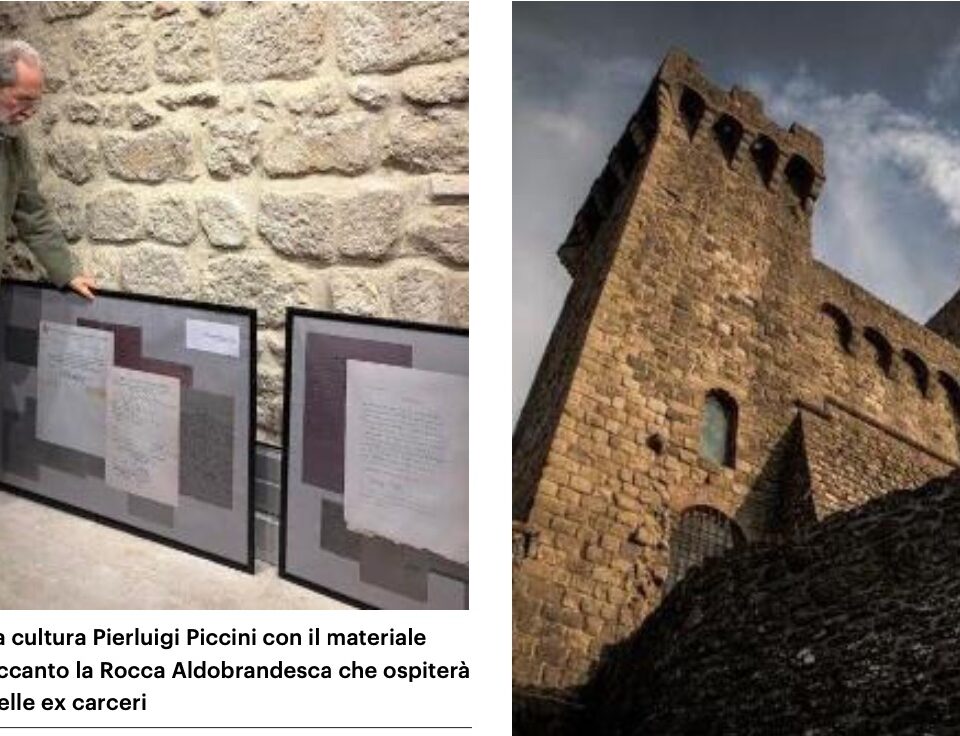
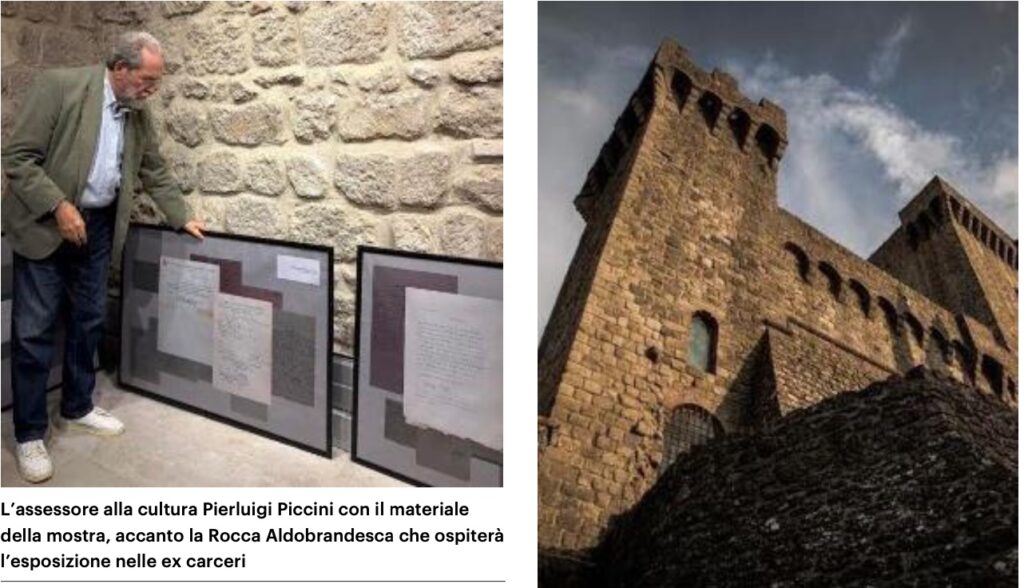
And behind, the Rocca. Stone upon stone, built to endure and to exclude, to control the territory and to wage war if necessary. It is a power that announces itself through matter, that needs no symbols because it is itself a symbol. The fortress wall does not murmur: it is silent, with the solidity of something that no longer has anything to prove.
Between the two — the golden crown on the living cypress and the dead fortress wall — Francesco Carone opens a dialectic of sovereignty that does not resolve. He does not say that nature defeats power, nor that power outlasts nature. He leaves the tension open, suspended, exactly like a murmur: something that can be sensed but not grasped, that carries meaning but refuses to be paraphrased. Gold carries with it the sacred, the solar, the regal without irony. A golden crown among cypress trees before a medieval fortress is almost an icon: an image that could belong to a fourteenth-century polyptych, where every element carries its precise symbolic weight and nothing is accidental. Carone works in this register, with the awareness that certain places already possess a sedimented visual grammar, and that to interfere with that grammar is the only way to say something new to it.
Mormorii is a title that works beneath the threshold of the declared. It does not shout, does not announce, does not explain. It whispers. And anyone who has ever paid attention to what lies just below the level of the perceptible — the rustling of cypress trees, the heavy silence of a medieval fortress, the vibration of a place that holds memory — knows that this is where the important things happen.
The Rocca Aldobrandesca of Piancastagnaio is not a neutral container. It is a place that already has its own language, its own stratification, its own symbolic resistance. To bring Mormorii inside means accepting a difficult dialogue, in which the work cannot simply occupy the space but must negotiate it. This is what Carone’s golden crown demonstrates: it begins before the threshold, addresses the visitor before they enter, places them in a state of listening.
This is what a place like this needs. Not to be illustrated, nor celebrated. To be listened to.
Mormorii opens on Saturday 28 March at 3 pm at the Rocca Aldobrandesca of Piancastagnaio.